
API vs Subscription: Which Costs Less for AI Chat?
Pay-as-you-go API or a $20 AI subscription? A worked, reproducible comparison with official prices as of 28 September 2026, and how to run your own numbers.
- For light and moderate chat, pay-as-you-go API usage usually costs less than a $20-a-month subscription such as ChatGPT Plus or Claude Pro; for heavy daily use of top models, the subscription can cost less. As of 28 September 2026, a typical message on a mid-tier model such as Claude Sonnet 5 or GPT-6 Sol costs about one cent through the API, estimated, so $20 covers roughly 2,000 such messages a month.
- The break-even point moves a lot with model choice and conversation length: about 1,000 messages a month on Claude Opus 5.5, but over 5,000 on Gemini 3.8 Flash, estimated.
- Subscriptions also include app features the API does not, and have usage limits of their own, so price is only part of the decision.
The two ways to pay
A subscription is a flat monthly fee for a provider’s own chat app. You pay the same whether you send ten messages or ten thousand, up to the plan’s usage limits, and you get the features built into that app. A pay-as-you-go API account bills per token: every message has a small cost that depends on the model and on how much text goes in and comes out.
You can use API access without writing code by pasting your own API key into a chat app — the "bring your own key" model. That is the comparison this article makes: the same everyday chat, paid either as a subscription or through your own API key.
Subscription prices, as of 28 September 2026
The table lists the individual plans most people compare, with US prices taken from each provider’s official pricing or help pages on 28 September 2026. Prices can differ by country and with local taxes, and providers change plans often; check the linked pages before relying on them.
| Plan | US price per month | Source |
|---|---|---|
| ChatGPT Plus | $20 | OpenAI Help Center, "What is ChatGPT Plus?" |
| Claude Pro | $20 billed monthly, or $17 a month billed annually ($200 a year) | claude.com/pricing |
| Claude Max | from $100 | claude.com/pricing |
| Google AI Plus | $4.99 | gemini.google/subscriptions |
| Google AI Pro | $19.99 | gemini.google/subscriptions |
| Google AI Ultra | from $99.99 | gemini.google/subscriptions |
How we estimate the cost of one API message
API prices are quoted per million tokens, with separate rates for input (what you send) and output (what the model writes). A token is roughly three-quarters of an English word. The estimated cost of a message is input tokens × input rate + output tokens × output rate.
For the examples below, a "typical message" is 2,000 input tokens and 600 output tokens. The input figure is larger than a single question because a chat app resends the earlier conversation with every turn; 2,000 tokens is about a question plus a few previous exchanges. The output figure is an answer of roughly 450 words. Your own averages will differ, and the calculator linked at the end lets you use your own.
Using that assumption and each provider’s published standard rates as of 28 September 2026, here is the estimated cost per message and per month at three usage levels: light (10 messages a day, 300 a month), moderate (40 a day, 1,200 a month) and heavy (100 a day, 3,000 a month).
| Model (input / output, USD per 1M tokens) | Per message | Light: 300 / month | Moderate: 1,200 / month | Heavy: 3,000 / month |
|---|---|---|---|---|
| GPT-6 Luna (0.10 / 0.50) | $0.0005 | $0.15 | $0.60 | $1.50 |
| Gemini 3.8 Flash (0.75 / 3.75) | $0.00375 | $1.13 | $4.50 | $11.25 |
| Claude Haiku 4.5 (1 / 5) | $0.005 | $1.50 | $6.00 | $15.00 |
| Claude Sonnet 5 (2 / 10) | $0.010 | $3.00 | $12.00 | $30.00 |
| GPT-6 Sol (2 / 10) | $0.010 | $3.00 | $12.00 | $30.00 |
| Gemini 3.1 Pro Preview (2 / 12) | $0.0112 | $3.36 | $13.44 | $33.60 |
| Claude Opus 5.5 (4 / 20) | $0.020 | $6.00 | $24.00 | $60.00 |
Where the break-even point sits
Dividing a $20 monthly fee by the estimated cost per message gives the number of messages at which the API costs the same as the subscription. Below that number the API is cheaper; above it the subscription is. As of 28 September 2026, with the typical message defined above:
The pattern is clear. With inexpensive models the break-even point is far above what most people send, so pay-as-you-go wins easily. With mid-tier models it sits around 60 to 70 messages a day, every day — more than many people send, but not an unusual amount for someone who uses AI throughout the working day. With the most capable models it falls to around 33 a day.
| Model | Messages per month for $20, estimated | Messages per day, estimated |
|---|---|---|
| GPT-6 Luna | about 40,000 | about 1,333 |
| Gemini 3.8 Flash | about 5,333 | about 178 |
| Claude Haiku 4.5 | about 4,000 | about 133 |
| Claude Sonnet 5 or GPT-6 Sol | about 2,000 | about 67 |
| Gemini 3.1 Pro Preview | about 1,786 | about 60 |
| Claude Opus 5.5 | about 1,000 | about 33 |
What changes the answer
The biggest variable is conversation length. Because each turn resends the thread so far, a long conversation raises the input side of every message. If your average input is 8,000 tokens instead of 2,000, a Claude Sonnet 5 message costs an estimated 8,000 × $2 / 1,000,000 + 600 × $10 / 1,000,000 = $0.022, and the break-even point drops from about 2,000 to about 909 messages a month, as of 28 September 2026.
The other variables pull in both directions:
- Reasoning models bill their thinking tokens as output, so hard questions can cost several times the typical figure.
- Attachments add input tokens for as long as they stay in the thread.
- Prompt caching, where the provider supports it, bills repeated context at a lower rate and pulls API costs down.
- Model mix matters: using an inexpensive model for most messages and a strong one only when needed often costs far less than using the strongest model for everything.
- Provider prices change, sometimes on a published date; Google, for example, lists a higher Gemini 3.8 Flash price from 1 January 2027.
What a subscription includes that the API does not
Price per message is not the whole comparison. A subscription buys a provider’s complete consumer app, which can include features such as voice conversations, image or video generation, deep research modes, file and project workspaces, and integrations that you would not get from a plain API key. If you rely on those, the API is not a like-for-like replacement.
Subscriptions also have limits. Plans describe their allowances in relative terms — Claude Max, for instance, is described as offering 5x or 20x more usage than Pro — and heavy users can reach them. The API has limits too, but they are rate limits you can raise by moving up a usage tier, not a monthly allowance.
In the other direction, the API gives you model choice across providers, pay-for-what-you-use billing, and per-message cost visibility. Many people end up with a mix: one subscription for the app they spend all day in, and API keys for everything else.
How to decide in five minutes
You do not need a general answer; you need yours. A short, honest estimate is enough to decide.
- Count a typical week of messages, not your busiest week.
- Decide which model you would use for most of them.
- Multiply by the estimated cost per message in the table above, or enter your numbers in the calculator.
- Compare the monthly total with the subscription you are considering, and note any subscription feature you would miss.
- If you are close to the break-even point, try the API for a month with a spending limit and check the actual bill.
Seeing the cost as you go
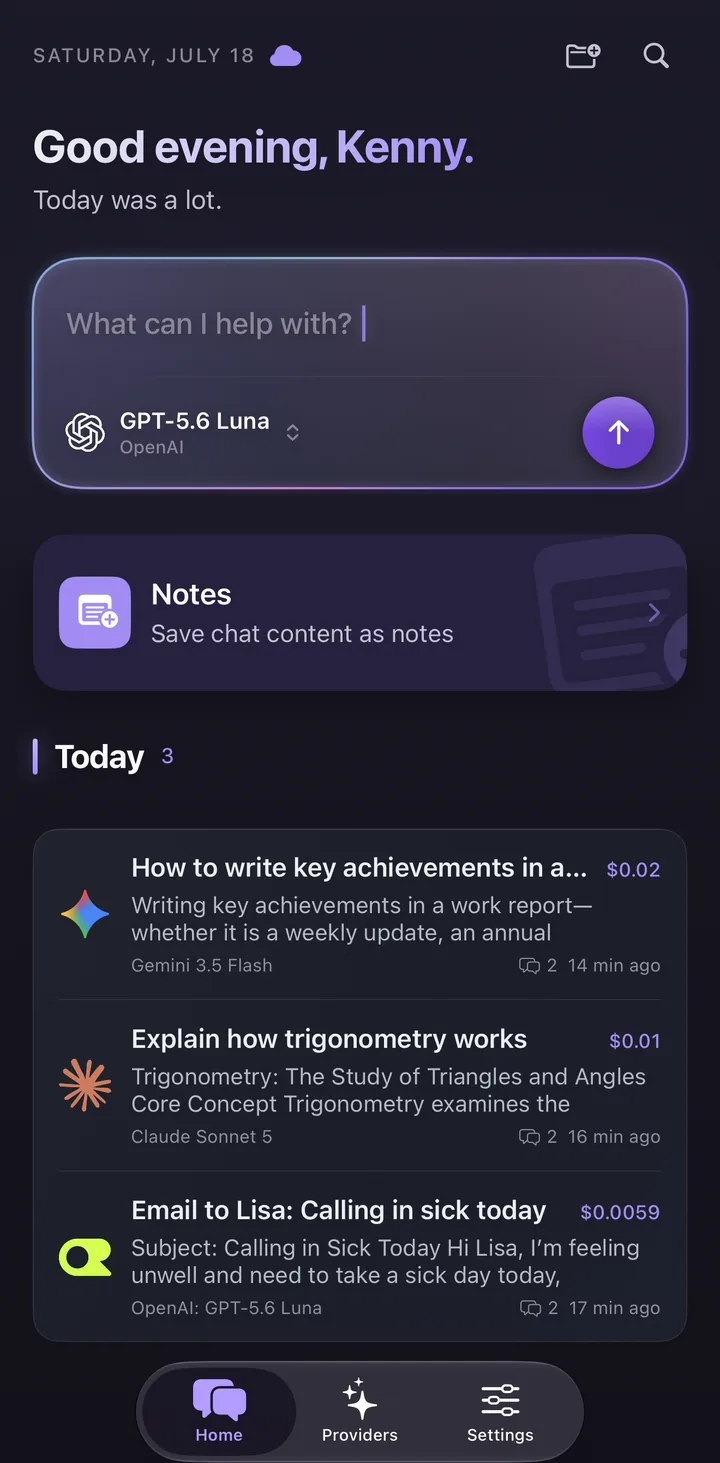
The most useful thing about pay-as-you-go is that you can watch it. Oriveo is a chat app for iPhone, Android and the web that connects your own keys for 15 official providers and shows an estimated cost on every message, calculated from the provider’s list price and the tokens the answer reports. With your own keys, each provider bills you directly and Oriveo adds no markup.
The estimate is there to steer your spending during the month. Your provider’s invoice is the final number, and when the two differ, the invoice is right.
Frequently Asked Questions
Is the ChatGPT API cheaper than ChatGPT Plus?
Is the Claude API cheaper than Claude Pro?
How many tokens is a typical chat message?
Does a subscription include API access?
Why are these costs labelled estimated?
Related reads
Watch the estimated cost of every chat
Oriveo shows an estimated cost on every message at the provider’s list price, across 15 official providers and 700+ models, on iPhone, Android and the web.